You are exhausted in a way that sleep does not fix. Your chest feels tight. Food has lost its taste. You argue with people you love over nothing. Money comes in and disappears. Someone tells you confidently that it is jadu. Someone else tells you just as confidently that it is stress.
Both of them might be right. That is what makes this question so difficult, and it is why guessing is the worst thing anyone can do with it.
Islam does not ask you to choose between medicine and ruqyah
This is the first thing to settle, because a great deal of harm comes from treating it as a choice.
"Allah has not sent down a disease without sending down a cure for it." — Sahih al-Bukhari 5678
The Prophet (peace be upon him) had ruqyah recited over him, and he also told people to seek treatment. Both are from the Sunnah. A person who refuses to see a doctor because they have decided their problem is spiritual has not become more religious; they have simply removed one of the two things Allah provided.
So the honest question is never "is it spiritual or medical". It is "what is going on, and what does each part of it need".
What the Sharia does affirm
Nobody should dismiss the unseen either. Both of these are established.
- Nazar is real. The Prophet (peace be upon him) said: "The evil eye is real." — Sahih al-Bukhari 5740
- Sihr is real. It is referred to directly in Surah Al-Baqarah 2:102, and Surah Al-Falaq teaches us to seek refuge from "the evil of those who blow on knots" (113:4).
What does not follow is that every hardship is one of these. Difficulty is also simply part of life, and Allah tests those He loves. Treating every bad month as an attack is its own kind of error, and it is an expensive one.
What usually points towards a medical cause
None of these is proof on its own, but together they carry weight:
- The symptoms are steady and present in every setting, rather than flaring in specific places or situations
- There was a clear starting point after a life event, a birth, a bereavement, a job loss, or a change in medication
- Close family members have had something similar
- Sleep, food and rest make a visible difference
- It began alongside a physical change such as weight loss, thyroid trouble, anaemia, or after childbirth
Iron deficiency, thyroid disorders and postnatal depression in particular produce exactly the heaviness, hopelessness and lack of appetite that get read as spiritual affliction. All three are common, all three are testable with a simple blood test, and all three are treatable.
What people commonly report with nazar
These are patterns people describe. They are not a diagnosis, and no honest person will tell you otherwise:
- A sudden change that followed closely after being admired, praised, or having something good become widely known
- Yawning heavily, tearing of the eyes, or a strong urge to sleep specifically during recitation
- Things going wrong in the exact area that was praised — the new business, the new marriage, the healthy child
What people commonly report with sihr
Again, patterns rather than proof:
- A sharp aversion to a specific person, often a spouse, that the person themselves finds irrational — when it is a marriage that turned cold overnight
- Unusual dreams that repeat, particularly of snakes, heights, graveyards, or being chased — though waking unable to move has its own explanation
- A strong reluctance to pray or to listen to the Quran, felt as heaviness rather than as a choice
- Something that came on abruptly with no explanation and did not follow any life event
A test you can run yourself, for two weeks
You do not need anyone's permission to start this, and it will tell you more than any stranger guessing over the phone.
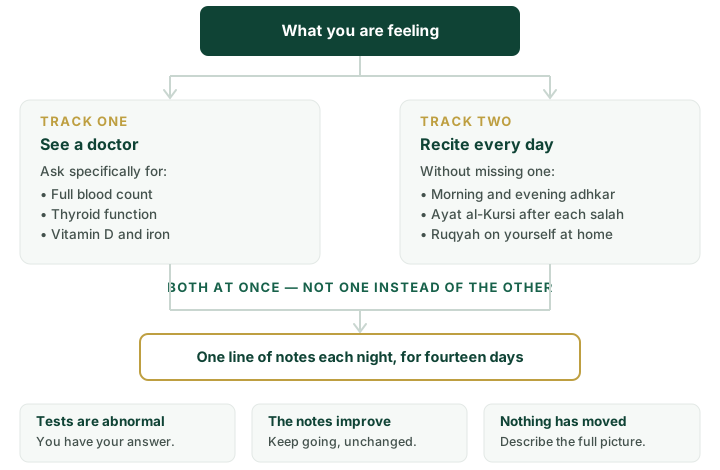
- Book the doctor's appointment. Ask specifically for a full blood count, thyroid function, vitamin D and iron. Do this even if you are certain the cause is spiritual.
- Recite the morning and evening adhkar every day without missing one. Consistency is the whole point.
- Recite Ayat al-Kursi after every obligatory prayer and before sleeping.
- Do ruqyah on yourself at home. You do not need anyone else present.
- Keep a short note each night. One line: how you slept, how you felt, what happened.
After two weeks you will have something nobody can give you second-hand — a record. If the notes show improvement, keep going. If the blood tests come back abnormal, you have your answer and you can treat it. If neither has moved, that is genuinely useful information too, and it is the point at which it makes sense to describe the whole picture to someone.
What we will not do
We will not tell you it is sihr in order to keep you coming back. We will not read your situation from your name or your mother's name, because there is no basis for that in the Quran or the Sunnah, and we will not name the person who did it — nor can anyone else. Any taweez or naqsh we write contains only the words of Allah, His names, Quranic numbers and Durood Sharif — what goes into one is set out in full here. We do not do sihr or tilsam, and we do not work with jinn — Shariah does not permit using them for our tasks.
What we will do is read what you actually write, answer from the Quran and authentic narrations with the source named so you can check it yourself, and tell you plainly when what you are describing sounds like something a doctor should see first.
Sources
- Quran 2:102, Surah Al-Falaq 113:1-5
- Sahih al-Bukhari 5678 — every disease has a cure
- Sahih al-Bukhari 5740 — the evil eye is real
- Sahih Muslim 2186 — the ruqyah recited over the Prophet (peace be upon him)